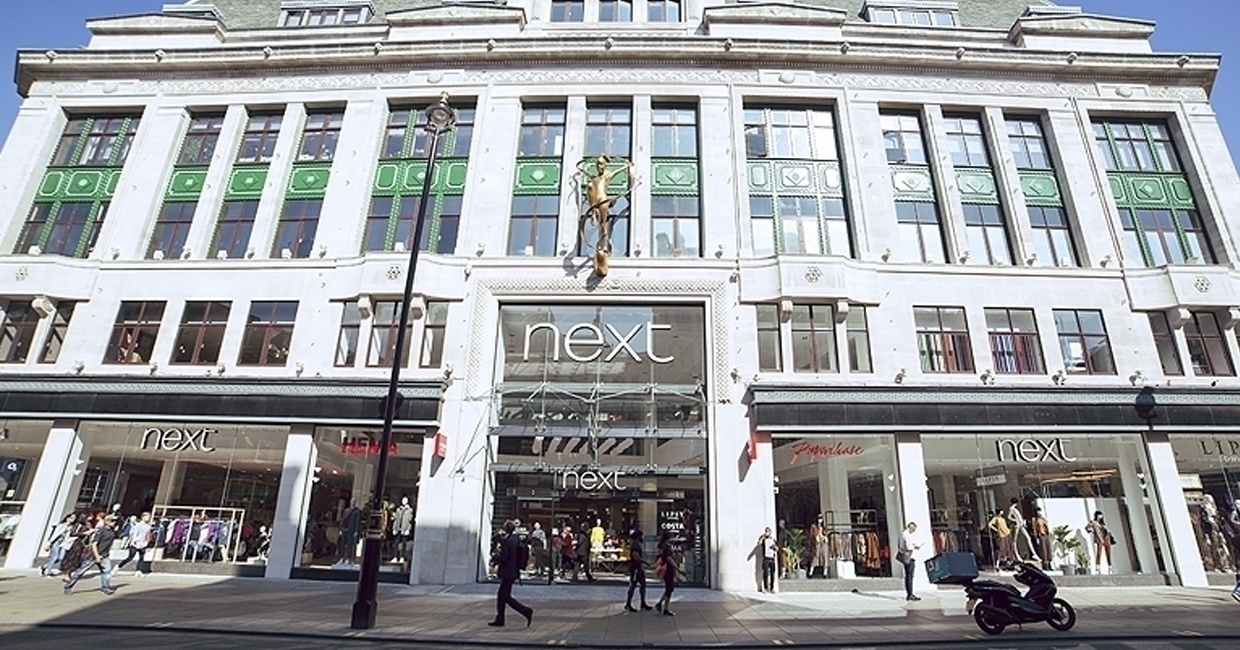
In the retail group's latest results report, Next chairman Michael Roney describes the 12-month period ended January 2026 as "very good year", which saw group PBT of £1,158m (up 14.5%) – due to better-than-expected full-price sales in January, along with improved clearance rates in its end-of-season sale – and Earnings Per Share (EPS) grow by 17.0%.
"Cash flow remained strong and we returned £839m to shareholders through a combination of dividends (£286.5m), share buybacks (£131.4m) and the B Share Scheme capital distribution (£421.5m)," he continues.
Full-price sales were up 10.9%, and total group sales (including subsidiaries) up 10.8%.
Next says these successes are thanks to the continued improvement and broadening of its product offer (own-brand, other wholly owned brands, and third-party brands), and growth in its international business.
Total online sales (including markdown sales) were up 10.2%, and sales from stores up 2.4%. As of January 2026, home furniture accounted for £9m of Next's full-price sales.
In personnel, HR director Jane Shields will retire after 40 years of service, including 13 years on the board, while Jonathan Bewes, the board’s senior independent director and leader of Next's audit committee, will step down at the 2026 AGM.
Annette Court and Jeni Mundy have joined the board as independent non-executive directors. Annette will take over Jonathan’s role as SID.
Guidance for full-price sales growth in the year ahead has been maintained, at 4.5%, and group pre-tax profit guidance has been increased to £1,210m, up 4.5% (£8m higher than the guidance given in January due to the increase in base profit mentioned above).
"Sales in the first eight weeks of the year were encouraging in the UK – they were also strong overseas up to the point the conflict began in the Middle East," Next elaborates.
"Looking forward, we have not yet reached the period of unusually strong UK trading we experienced last year and, perhaps more importantly, instability in the Middle East – which represents around 6% of our total turnover – may continue to restrain growth in that region. It is also likely to have knock-on effects on costs, selling prices and consumer demand in the rest of the business.
"We have accounted for £15m of additional costs that are likely to arise from the conflict, such as fuel and air freight, on the assumption that the disruption lasts for three months. These costs have been offset by savings elsewhere, so do not affect our guidance. Beyond the next three months, if we see these costs persist, then we will begin to pass costs through as higher pricing – but for today that remains a contingency not a plan.
"At this point, the longer-term implications of the conflict are uncertain, and Next is not well placed to make predictions. As yet, we have no feel for the medium-term effects on supply chain resilience, freight rates, factory gate prices and consumer demand. Much will depend on how long the conflict persists, and how much permanent damage is done to the world’s energy infrastructure. We will give a more detailed update with our first quarter trading statement on 6th May. We believe we will have a much clearer picture by then."
In the year ahead, Next plans to open eight new store locations and five standalone Bath & Body Works stores, while two stores will be re-sited to new locations.