There's a reason sheet goods dominate modern furniture, writes MEDITE Smartply: "Walk into any decent workshop and you'll find the same conversation playing out. Someone wants a flawless painted finish on a wardrobe door. Someone else needs a worktop that won't sag across a 900mm span. The timber itself gets all the glory, but sheet materials are doing most of the heavy lifting in contemporary furniture production, and the choice you make at the ordering stage dictates almost everything that follows …"
Get it wrong and you're sanding edges that refuse to take paint, or watching a shelf bow six months after delivery. Get it right and the piece just works.
Why sheet goods dominate modern furniture
Solid timber moves. It always has and always will. A 600mm wide oak panel can expand and contract by several millimetres across the grain depending on the season, which is fine if you're building a traditional frame-and-panel chest designed to accommodate that movement. It's a problem if you're producing flat-pack units with 2mm tolerances.
Engineered boards sidestep this entirely. They're dimensionally stable, available in consistent thicknesses, and come in sheet sizes that make efficient cutting plans possible. The standard 2440 x 1220mm sheet has become the backbone of British furniture manufacturing for good reason, though larger formats at 3050mm are increasingly common for taller wardrobe applications.
There's also the cost argument. A cubic metre of kiln-dried European oak will set you back considerably more than the equivalent volume in veneered MDF, and the veneered option gives you a more predictable result.
Therefore, it pays to understand your main options.
MDF and its variants
Medium density fibreboard (MDF) remains the default for painted work, and nothing else comes close for edge quality. Machine a profile into the edge of a good MDF panel and you get a surface that takes primer beautifully. Try the same with chipboard and you'll be filling for days.
Quality varies enormously between suppliers, though. Cheaper boards often have inconsistent density through the thickness, which shows up when you're routing deep profiles or fitting hardware. Premium options like Medite MDF boards maintain more uniform density and tend to machine cleaner, which matters when you're producing dozens of identical components and can't afford variation.
The specialist grades are worth knowing. Moisture-resistant MR grade for bathroom and kitchen applications. Flame-retardant versions where building regulations demand them. Ultralight boards for furniture that needs to be shifted by hand, where weight savings of around 30% make a genuine difference to installers.
Plywood
Birch ply has had something of a renaissance. That striped edge has become a design feature in its own right, appearing in everything from Scandinavian-inspired kitchens to office furniture. Structurally it outperforms MDF considerably, with far better screw holding and significantly less deflection over long spans.
The downside is cost and consistency. Even good birch ply contains occasional voids, and face veneer quality can disappoint if you're buying the cheaper grades. Specify B/BB or better if the faces are visible.
Chipboard and melamine-faced boards
Unglamorous but genuinely useful. Melamine-faced chipboard (MFC) eliminates finishing work entirely, which is why it dominates volume kitchen production. Modern decors have improved dramatically too – some of the textured woodgrain finishes are convincing enough that clients don't immediately clock them as laminate.
Use it for carcasses, hidden structures and anywhere the edge can be banded. Don't use it where moisture is likely or where screws will be repeatedly removed and refitted.
Matching material to application
A few principles that save grief: painted doors and panels – MDF, ideally 18mm or 22mm for larger sizes to resist bowing; visible shelving over 800mm – plywood, or MDF with a stiffening batten; carcass construction – melamine faced chipboard or 15mm MDF, depending on budget; curved work – flexible MDF or bending ply, laminated in multiple layers; and wet areas – moisture resistant grades, always, with edges sealed properly.
Thickness deserves more thought than it usually gets. The jump from 18mm to 25mm adds meaningful cost but can eliminate the need for additional support structures, often working out cheaper overall once labour is counted.
Sustainability and sourcing
Clients ask about this now, and specifiers increasingly demand documentation. FSC and PEFC certification has become table stakes rather than a selling point. Many manufacturers have moved to zero-added-formaldehyde adhesive systems, and European boards generally meet E1 emission standards as a minimum.
It's worth checking where the board was actually manufactured. Transport emissions aside, European production standards are typically tighter than imports from further afield, and the consistency tends to reflect that.
Buying well
Build a relationship with a supplier who'll cut to size accurately. The savings on waste and workshop time usually outweigh any premium on the sheet price. Ask about batch consistency if you're running a project across several months, because colour variation in melamine decors between production runs is a genuine headache.
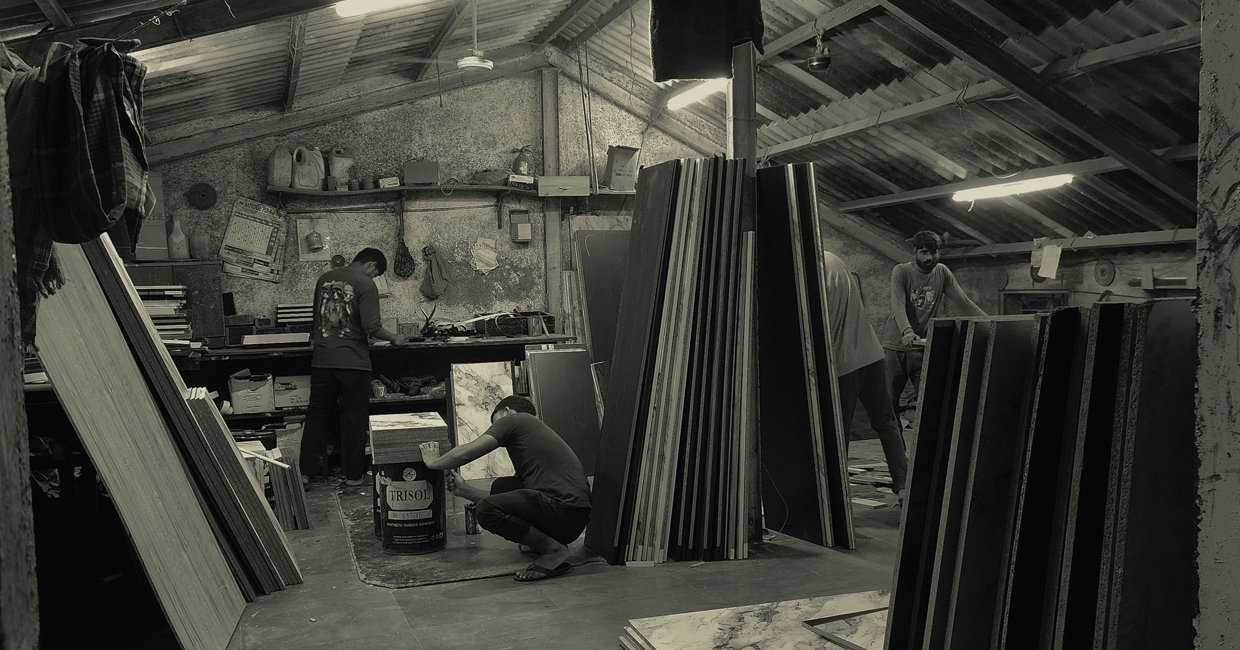
And store boards flat. Stacked vertically against a wall, even good MDF will develop a bow within weeks that no amount of clamping will fully remove.
Photo courtesy Unsplash/Zoshua Colah