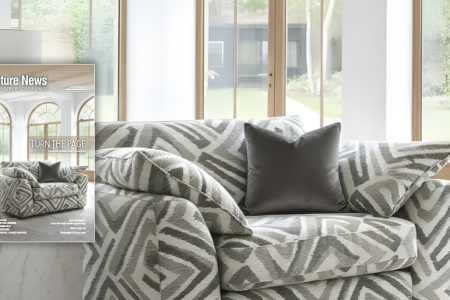

When developing and deploying new furniture and furnishings, it pays to look ahead. With consumer tastes taking several new directions in 2026-27, Furniture News has again quizzed the industry’s top buyers and trend forecasters on the colours, materials and shapes seeing rising demand, and the lifestyle changes behind them. Here, Tom Bourne, creative director at PR and marketing agency Select First, shares his predictions …
For more than 30 years, we’ve helped shape and share the voices of leading interior brands, and over that time, we’ve witnessed a powerful shift in the industry’s priorities. What began as a focus on style and surface has evolved into a deeper, more conscious movement, where sustainability, accountability and ethical responsibility are just as important as aesthetics.
While design trends come and go, the commitment to responsible sourcing, transparent production and long-term environmental impact has become a defining value. Today’s interiors are not only expected to look beautiful but to act responsibly, reflecting an awareness of the materials, people and processes behind every product.
Supporting local artisans and craftsmanship
A defining shift in 2026 interiors is the renewed focus on local craftsmanship and authenticity. As the design world continues to move away from mass-produced uniformity, homeowners, designers and specifiers are seeking out pieces that carry a story, one that connects them to either people, place or process. Working with local artisans not only adds emotional and cultural value but also reinforces a more sustainable approach to making, by reducing transport emissions and supporting local economies.
End-of-life responsibility and circular interiors
In 2026, the conversation around sustainability has evolved beyond sourcing and production – it now extends to what happens when a product reaches the end of its life. End-of-life responsibility is fast becoming a defining principle in modern interior design, urging manufacturers, specifiers and consumers to consider how materials can be reused, repurposed or regenerated rather than discarded. This marks a shift from the traditional linear model of ‘make, use, dispose’ to a circular mindset that values longevity, adaptability and renewal.
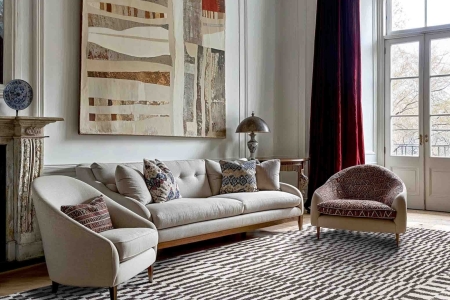
Structures Berber collection, Louis De Poortere
Forward-thinking brands are introducing take-back schemes and closed-loop systems, where flooring, furniture and textiles can be returned for recycling, refurbishment or reinstallation. Products are being designed with disassembly in mind, using modular components and reversible fixings so materials can be separated and reused with ease.
Ultimately, circularity represents a holistic approach to design, one that considers not only how something looks or functions, but what happens next. Every design choice becomes an opportunity to reduce waste, preserve resources, and create systems that give back more than they take.
In 2026, the spaces we inhabit are no longer static – they are part of an ever-evolving ecosystem that connects material, maker and environment in a continuous loop of responsibility.
Discover more predictions from industry experts in January's issue.