Furniture manufacturers are pouring money into warehousing and production capacity this year, from new distribution hubs to upgraded factory lines – and the numbers behind that growth are worth pausing on, writes Annie Button …
One recent example is a new furniture logistics and distribution centre in Leamington Spa offering more than 35,000 pallet spaces. It gives a sense of the scale some furniture businesses are now storing and moving stock at.
That kind of expansion brings real operational upside, but it also concentrates risk in ways that are easy to overlook until something goes wrong. A bigger site means more stock in one place, more vehicle movements across the yard, and more distance between where a problem starts and where someone notices it.
Fire risk is easy to underestimate in storage areas
Furniture warehouses typically hold large volumes of combustible material, from raw timber and foam to packaged finished stock, often stored close together to make the best use of available space. Government fire safety risk assessment guidance for factories and warehouses is direct about where this goes wrong. Fires starting in high racking can reach the top of the stack within two minutes. Clearance from ceilings and between aisles has a real bearing on how fast a fire spreads.
Reducing stock density in open areas and keeping combustible materials away from ignition sources are basic steps, but they are the ones inspectors and insurers come back to most often after an incident.
Furniture stock is particularly unforgiving in this respect. Foam-filled upholstery, timber offcuts and packaging materials all burn readily and can produce dense smoke quickly. That is why creating physical breaks between storage bays matters as much as reducing the volume of stock held at any one time.
Forklifts and pedestrians need clear separation
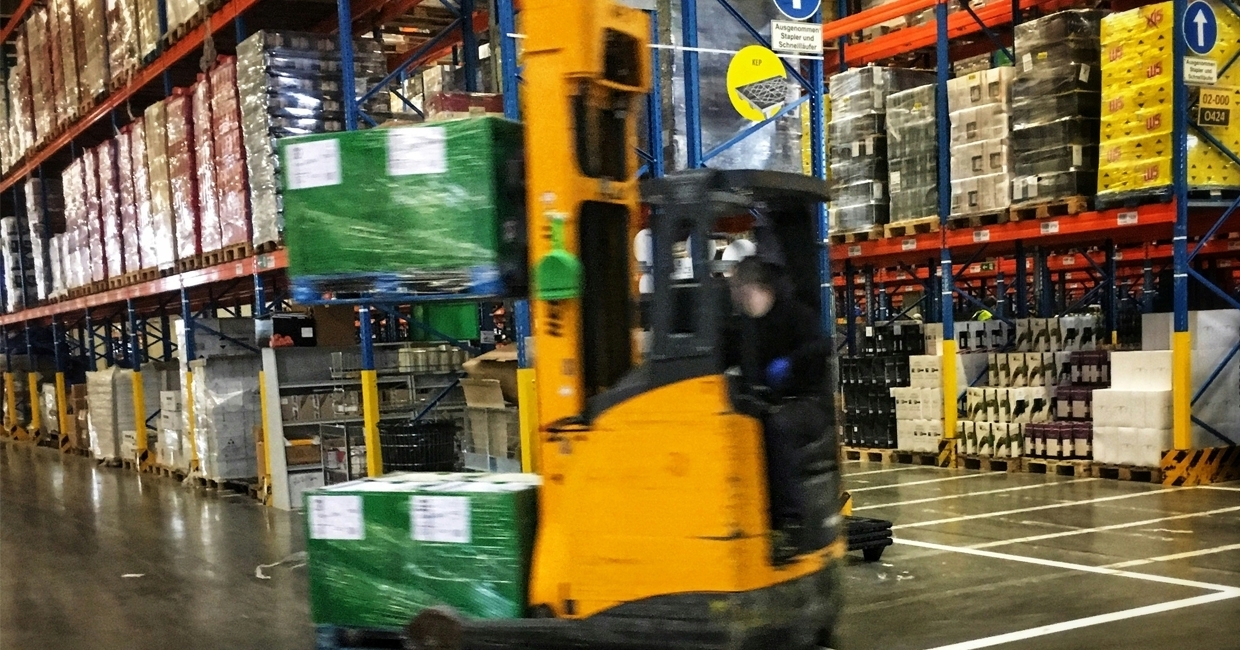
Vehicle movement presents a different but related challenge. Forklifts and delivery vehicles share yards and warehouse floors with staff on foot, and HSE guidance on workplace transport safety treats this as one of the most persistent causes of serious injury in industrial settings.
Clearly defined vehicle routes, physical segregation between pedestrian and vehicle areas, and controlled loading zones reduce the chance of a collision considerably, particularly around busy goods-in and goods-out points where forklifts are working at pace. Many of the more serious incidents happen not on the open floor but at the edges of a site, around loading bays, delivery entrances and material storage areas. That is where vehicles and people are most likely to be working close together without a clear line of sight.
Physical segregation offers a practical fix
Keeping combustible stock separated and keeping vehicles away from people on foot are two different problems, but physical segregation is one of the more practical ways manufacturers are addressing both without disrupting day-to-day production. Interlocking concrete blocks, for example, are designed for exactly this kind of application, creating defined material storage bays, fire-break separation between stock areas, and clear vehicle exclusion zones around high-traffic parts of a site.
Barrier specialists Maltaward note that the blocks are modular and can be assembled and reconstructed within hours. That flexibility suits manufacturers whose storage needs shift as production volumes or stock types change, or who operate across multiple sites where permanent structural work is not always practical.
Manufacturers are already investing in safer operations
None of this is lost on furniture manufacturers currently investing in their operations. Kaymed’s recent £3m transformation of its Bluebell and Kilcullen facilities included new production equipment alongside upgrades aimed at improving manufacturing efficiency and consistency.
That kind of investment tends to go hand in hand with a harder look at how material and stock are stored and moved around a site. New equipment and higher throughput generally mean more stock moving through a facility at any given time, which puts extra pressure on storage layouts and traffic routes that were designed for a smaller operation.
Warehouse risk does not stay the same for long
The wider point is that warehouse and yard risk rarely announces itself in advance. A storage layout that worked when a facility opened can become a liability once volumes grow or new product lines are added.
Manufacturers managing this well tend to treat it as an ongoing part of running the site, not a one-off compliance exercise. That usually means revisiting storage and traffic layouts whenever production volumes shift, rather than waiting for an annual review or a near miss to prompt the conversation. It also means involving the people who actually work around the racking and the forklifts, since they tend to spot the pinch points in a layout long before an inspection does.
With investment in furniture manufacturing capacity continuing at pace, getting the basics of fire separation and vehicle segregation right now will matter more, not less, over the next few years.
Photo courtesy Unsplash/hdbernd