When many people imagine environmentally friendly or sustainable products, they often picture something dull, limited in functionality, or made from materials not traditionally associated with a given application – but designers and manufacturers working in the sustainability space understand that this perception no longer holds true, writes John Hubbard, sustainability expert at the Furniture Industry Research Association (FIRA) …
A commonly cited definition of sustainability states that “sustainable development meets the needs of the present without compromising the ability of future generations to meet their own needs.”
Those needs are not solely functional – they are aesthetic as well.
Furniture plays a critical role in shaping the spaces in which people live and work, contributing to comfort, productivity and mental wellbeing. On this first test of sustainability – fitness for purpose – design and fashion already make a meaningful contribution. The question, then, is how individuality and style can be retained when sustainability considerations are fully embedded in furniture choices.
Durability must be the starting point. Furniture designed to last many years has a significantly lower environmental footprint than less robust alternatives requiring frequent replacement. Longevity is not just an environmental objective, but also a marker of good design.
Reuse can also be a deliberate design and procurement choice. Many furniture items are discarded before reaching the end of their functional life. Specialist businesses are now emerging that assess such furniture and determine whether it can be given a credible second life, either as individual pieces or in larger quantities.
A common concern with reuse is achieving sufficient consistency to complete a full fit-out. However, eclectic design can be a strength rather than a limitation. Deliberately varying the look and feel of different departments or zones within a building can enhance wellbeing and allow a broader range of reused products to be considered during the design stage.
Modular design supports this approach. Furniture that can be reconfigured allows layouts to evolve over time, refreshing a workspace without wholesale replacement. Where modularity extends to upholstered components, covers can be removed and replaced while retaining most of the structural elements.
Upholstered furniture often appears worn long before its structure ceases to be fit for purpose – re-upholstery is frequently a faster, cheaper and more sustainable alternative to replacement.
For this to work effectively, ease of disassembly must be considered at the design stage. Components should be removable using simple techniques, favouring zipped or click-fit fabrics over adhesives and staples, which are time-consuming to remove and hinder repair or refurbishment.
Despite this progress, challenges remain before circularity can be fully embedded into business models. Identifying, storing and redistributing bulky furniture items is complex. Many pieces must be reused quickly or risk becoming waste – particularly upholstered furniture, which often ends up incinerated. There is currently no established mechanism to connect end-of-life furniture with networks of dealers able to incorporate reused pieces into new project plans, although the industry is increasingly exploring how such systems might develop.
Improving access to reliable product information will be critical. In the EU, planned Digital Product Passports are expected to provide details on chemical treatments used in fabrics, foams and coated materials, alongside guidance on repair, refurbishment and end-of-life options. This greater transparency has the potential to unlock new reuse and circularity opportunities.
Furniture remains central to interior design, with many spaces driven by strong creative concepts. Yet at every stage, from specification to end of life, environmental considerations are now an essential part of the brief. With innovation and imagination, the industry is well placed to integrate sustainability without compromising style, individuality or performance.
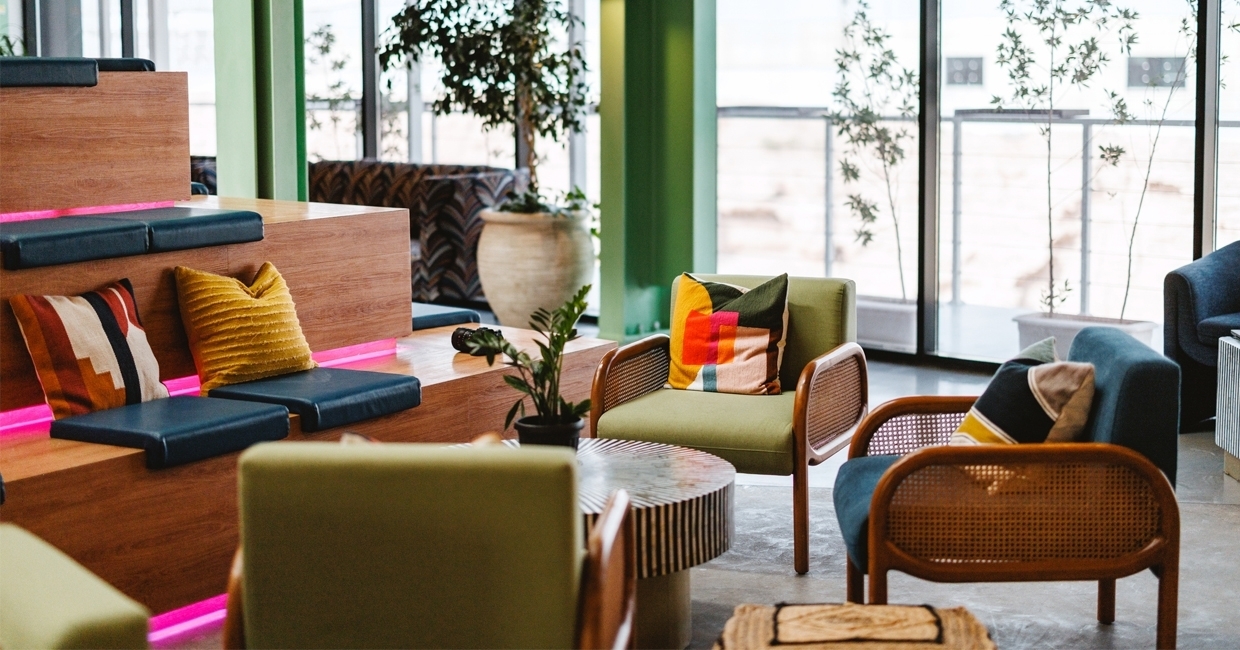
Pictured: Sustainability is often built into contemporary furniture design (photo courtesy iStock/AzmanJaka)