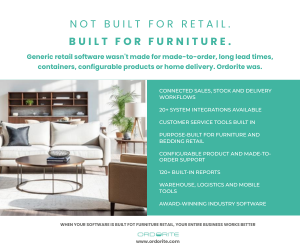

Furniture retail has always been complex, says retail management and ERP software specialist, Ordorite – configurable products, long lead times, high-value transactions and intricate delivery logistics mean success depends on precision, visibility and control. Yet many retailers still rely on disconnected systems, spreadsheets and manual processes never designed for modern retail …
As the industry evolves, more businesses are moving to integrated furniture retail software, recognising that how they operate matters as much as what they sell.
At its core, furniture retail software brings every key function into a single, connected platform. Sales, stock control, delivery scheduling, finance and customer data work together rather than in isolation, giving a consistent, accurate view of performance and removing the duplicate entry and inconsistencies that arise when systems do not communicate.
The limitations of traditional set-ups are increasingly apparent. Fragmented data means time lost reconciling information, reliance on outdated reports, delayed decisions and missed opportunities. Individually minor, these inefficiencies have a cumulative impact on profitability, customer experience and the ability to scale.
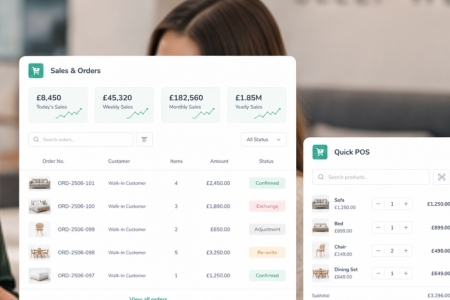
Integrated systems, by contrast, provide real-time visibility across every store, warehouse and department, from sales performance and stock levels to delivery status and financial data. This clarity enables faster, more confident decision-making and allows businesses to respond to challenges as they arise, rather than after the fact.
Inventory management improves immediately. With accurate, real-time data, retailers avoid tying up cash in slow-moving stock while keeping high-demand products available. Delivery operations also benefit, with integrated scheduling enabling more efficient route planning, better resource allocation and clearer customer communication.
Perhaps the most overlooked advantage is the reduction in administrative workload. Tasks such as stock reconciliation and reporting can be automated, freeing teams to focus on customer service, sales and strategic planning.
Growth makes integration even more important. Additional stores, larger inventories and higher delivery volumes add complexity that quickly becomes hard to manage. An integrated platform provides the infrastructure to scale efficiently while keeping processes consistent and visibility intact.
The direction of travel for the furniture and bedding sector is clear. Retailers who invest in connected, end-to-end systems are better positioned to operate efficiently, deliver a stronger customer experience and adapt to changing market conditions. Platforms such as Ordorite are built specifically for this environment, combining operational functionality with real-time insight through tools like Vision IQ.